
At a Glance
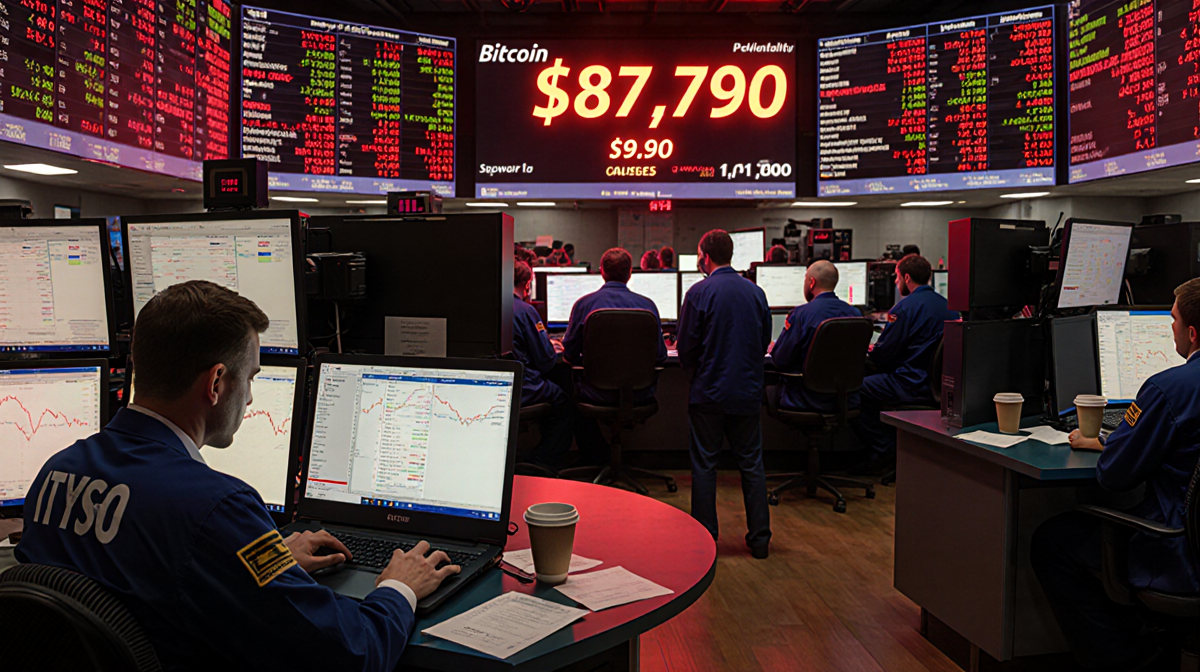
- Bitcoin fell to $87,790, its lowest since Dec. 31.
- Over the last 48 hours, more than $1.8 billion of positions were liquidated.
- Japanese 10-year bond yields surged nearly 19 basis points, sparking a global liquidity squeeze.
- Why it matters: The sharp decline in Bitcoin and crypto markets reflects heightened sensitivity to liquidity conditions amid geopolitical tensions.
Bitcoin has taken a hard hit, slipping 10 % from its year-to-date high of just under $98,000 and erasing all gains made in January.
Bitcoin’s Sharp Drop
Bitcoin closed at $87,790 on Coinbase in late trading on Tuesday, the lowest level since Dec. 31. Over the preceding 48 hours, more than $1.8 billion of positions were liquidated, with around 93 % of them long, according to Coinglass. The asset also fell below its 50-day exponential moving average, a key support level that had helped sustain the recent rally.
The loss of value has been mirrored across the broader crypto market, which has shed a collective $225 billion in market capitalization. This decline is the largest since mid-November, bringing total crypto market cap to $3.08 trillion.
Ripple Effects from Japan
The turmoil in the Japanese bond market has been cited as a major driver of the recent volatility. Japanese 10-year government bond yields surged almost 19 basis points over two days, while 30-year yields recorded their biggest daily jump since 2003. The spike reflects investors’ concerns over increased government spending and a tightening of liquidity.
Jeff Ko, chief analyst at CoinEx Research, explained the bond surge to {brand}:
> “The surge in Japanese bonds was driven by fiscal uncertainty and market volatility ahead of the snap election. This threatens to accelerate the carry trade unwind, further tightening a critical source of global liquidity,” he said.
He added that a capital war may be emerging:
> “Beyond the trade war, a capital war appears to be emerging. Fund flows are shifting away from US assets as geopolitical tensions mount. Bitcoin finds itself caught in a tug-of-war – while it shares characteristics with hard assets like gold, it’s currently being sold off due to its heightened sensitivity to liquidity conditions.”
Trade War and Market Sentiment
President Donald Trump’s renewed tariff threats have also played a role. The so-called “Sell America” trade, which emerged after last April’s tariff announcement, was revived by Trump’s recent statements, according to Reuters. While many attribute the market volatility to the trade war escalation, other factors are at play.
Dan Tapiero, founder and CEO of 50T Funds, told {brand}:
> “The wipeout was caused by complete annihilation in Japanese bond markets infecting all markets right now.”
Tapiero also predicted a rise in gold, which hit an all-time high of $4,835 per ounce on Tuesday, and suggested Bitcoin might follow.
US Treasury Secretary Scott Bessent echoed this view, stating:
> “I believe markets are going down because the Japanese 10-year bond market had a six-standard-deviation move over the past two days. This has nothing to do with Greenland.”
Market Dynamics and Liquidity
The sudden spike in Japanese bond yields has tightened a critical source of global liquidity. This tightening has amplified the sensitivity of Bitcoin and other crypto assets, which often act as liquidity-driven investments. When liquidity dries up, these assets become more volatile and prone to sharp sell-offs.
The combination of trade-war rhetoric, Japanese bond market turbulence, and global liquidity concerns has created a perfect storm for crypto markets. Bitcoin’s recent slide is a clear illustration of how interconnected global financial systems have become.
Looking Ahead
Analysts warn that the current environment could lead to further volatility in both traditional and digital asset markets. If the Japanese bond market continues to tighten, or if the trade war escalates, we may see additional sell-offs across asset classes.
Investors are advised to monitor liquidity indicators closely and remain cautious about over-leveraged positions in volatile markets.
Key Takeaways
- Bitcoin’s 10 % slide erases all January gains and drops below critical support levels.
- The Japanese bond market’s sharp rise has tightened global liquidity, amplifying market volatility.
- Trade-war rhetoric and geopolitical tensions continue to weigh on investor sentiment.
- Analysts predict further sell-offs if liquidity conditions worsen.
By staying alert to liquidity signals and geopolitical developments, market participants can better navigate the uncertain terrain ahead.